PRODUCT · GAME DESIGN
Salt Run
A tabletop game about extraction.
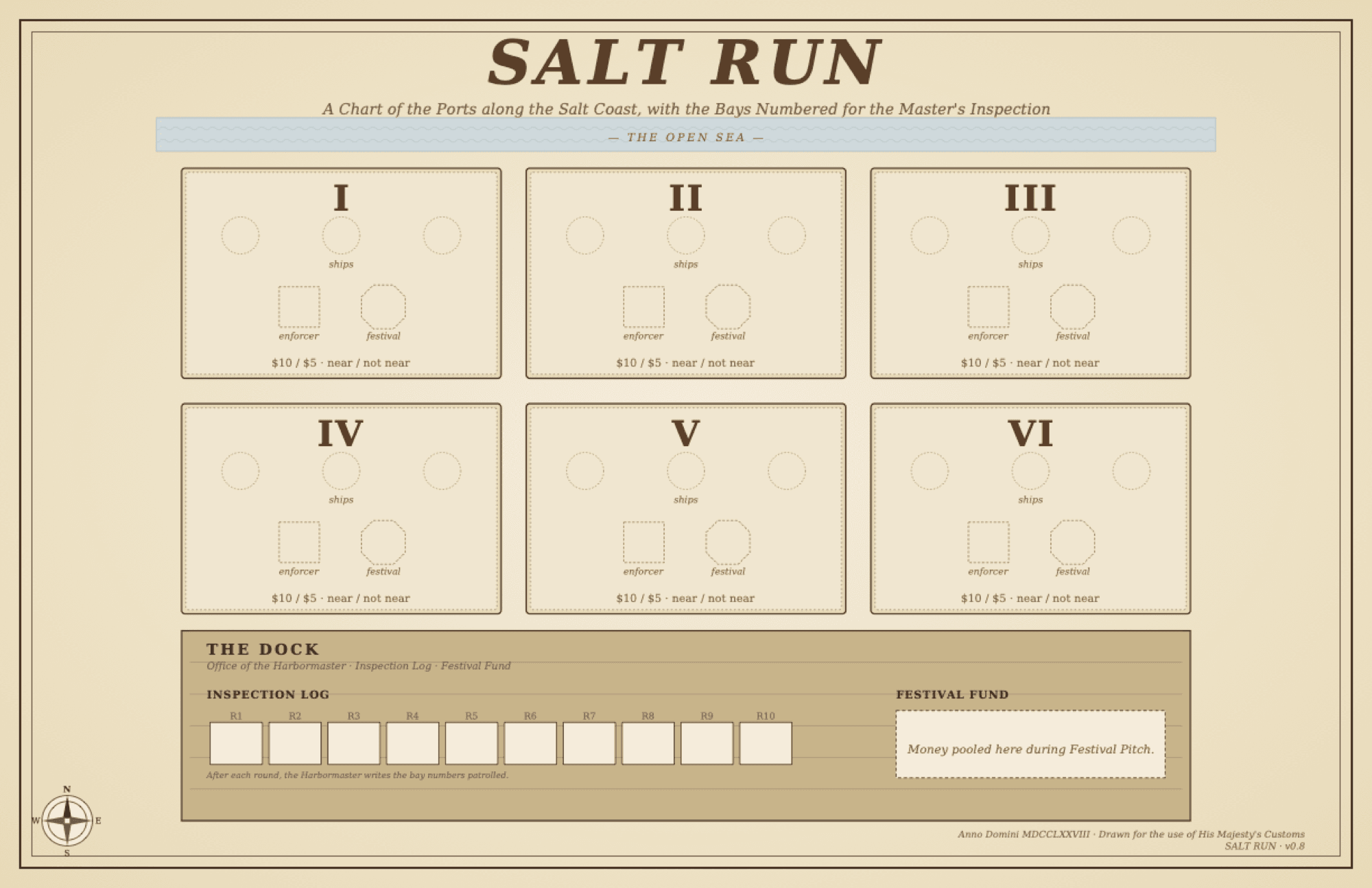
The coast — six bays, three smugglers, one harbormaster.
The inspiration
What does it feel like to be inside a system that collects from you no matter what you choose?
Salt Run is a four-player tabletop game about extraction. Three Smugglers move salt along a coastline. One Harbormaster collects revenue for the Crown. I made it as a grad project in Stanford’s Earth Systems department.
The starting intention was small and personal. I wanted to model Stanford parking. What I actually wanted to model was the feeling of being squeezed by a structure I couldn’t opt out of, where every option had a cost and the cost was the point. Parking was just the instance.
The experience I wanted at the table: a slow agreement that running dark was the best option, even though it can feel like getting squeezed over the long run.
The argument
Some can afford to opt out.
Some can only run dark.
Some can organize.
The system collects either way.
Opt out
Buy a Letter of Marque for $7. You skip the riskiest phases of the round. The catch is that you need money you don’t always have.
Run dark
Move salt for free. Lose $15 if a patrol finds you. This is the only option when you can’t afford anything else.
Organize
Pool money into a festival. If the table reaches $15, that bay is free this round. Fall short and the Harbormaster keeps the pile.
How it plays
Eight rounds. One coast. Four players who all know what the others want.
Each round, every Smuggler privately picks a method (run dark or buy a Letter), draws a Buyer card that tells them which bays will pay full price, declares a bay out loud (they can lie), and then secretly commits to where their ship actually lands. The Harbormaster has heard the declarations. They place enforcers blind.
A bay near your buyer pays $10. A bay that isn't pays $5. Two Smugglers at the same bay split the take. A patrol finds you running dark, you lose $15. Letters of Marque are immune to all of this and always pay $10. Festivals override enforcement at one bay for one round.
Smugglers win by ending round 8 with the most cash. The Harbormaster wins by collecting $60 in revenue. Both can win, both can lose. The Smugglers can go negative and still beat each other while losing the game outright.
Smuggler turn
- Method commit (dark or Letter, face-down)
- Reveal Letters & Harbormaster hires
- Draw a private Buyer card
- Festival pitch — contribute, persuade, or stay out
- Declare your bay aloud (you may lie)
- Commit your real bay, secretly
- Reveal & resolve revenue
Harbormaster turn
- Decide on hires (default 2, up to 4)
- Announce hires to the table
- Watch who contributes to a festival
- Listen to declarations — read tone, repetition
- Place enforcers secretly (not at the festival bay)
- Collect $15 per dark Smuggler at a patrolled bay
- Stay quiet during Declare. Don't bargain.
The characters
Four people. Four starting balances. The inequality is the point.
Lucia starts with $60 because she's rich — not because her uncle holds a Letter of Marque. Mira starts with $40 because she's middle class. Davi starts with $25 because he's lower class and the system has already taken from him. Voss starts at zero. His pension is calculated against the revenue he collects.
Lucia Bellandi
$60Licensed Merchant — the rich one
Born into money. Starts with more because her family has more — that's the whole advantage. Her uncle happens to hold a Letter of Marque, but it's irrelevant to why she's ahead. Pays her gabelle on time, in full, with a smile, and doesn't think about it much.
Mira Costa
$40Faux-Saunier — the cautious one
Two children, a sick mother in Lisbon. Pays her bribes on time. Knows three gabeleurs by name and which pocket they prefer. Doesn't run dark anymore — she lost a cousin to a salt patrol.
Davi Rocha
$25Faux-Saunier — the desperate one
Twenty-six. Owes money to people who don't keep ledgers. Has been seized twice — once they took a season's worth of salt, once they took two of his teeth. Tells himself the next run clears the debt.
Inspector Kael Voss
$0 → $60Gabeleur — the system, in human form
Twenty-eight years collecting the salt tax. Pension calculated against gabelle revenue, which he thinks about more than he should. Tells himself he's keeping order. Sometimes believes it.
Bumps along the way
Three versions. Six weeks. Classroom playtests at weeks 4, 5, and 6.
v1 — Stanford parking. (Week 4 playtest)
Literal. Players competed for parking spots and a parking enforcement officer extracted fees. The game didn't do what I wanted it to. The metaphor was too close to the thing: playtesters approached it the way they’d approach parking in real life — most just paid for parking rather than risk going dark — and the game-logic of it never took hold. They weren’t engaging with it as a system; they were re-enacting a habit. No distance, no friction, nothing to see.
v2 — Reskin to salt. (Week 5 playtest)
18th-century France, the gabelle, six coastal bays. The distance worked. I also collapsed the pricing: seven prices and weighted dice became $10/$5 and one Letter price. The question got sharper as the math got dumber. But this version still had too many mechanisms — there were different priced “permits”: you could bribe for one safe port, or buy the Letter of Marque for total freedom of movement. On top of that the game played as a fatalistic dilemma, with players acting against the system in parallel rather than with each other. I tested declarations informally during this playtest — Smugglers calling their bay out loud, with the option to lie — and it changed the table immediately. I kept it official for v3.
v3 — Declarations and festivals. (Week 6 playtest)
Two additions. First, Smugglers now declare their bay out loud before committing, and they can lie. That single rule turned individual optimization into a social game. There was tone, repetition, and pattern to read. Second, festivals: any player can propose one, the table contributes openly, and at $15 the bay becomes immune to enforcement. Below $15 the Harbormaster keeps the pile. The festival rule is what made playtesters feel how hard collective action is when one player starts with $60 and another with $25. The week-6 group didn’t debrief the rules. They debriefed what had just happened between them.
The latest version
v3 — what works, and why.
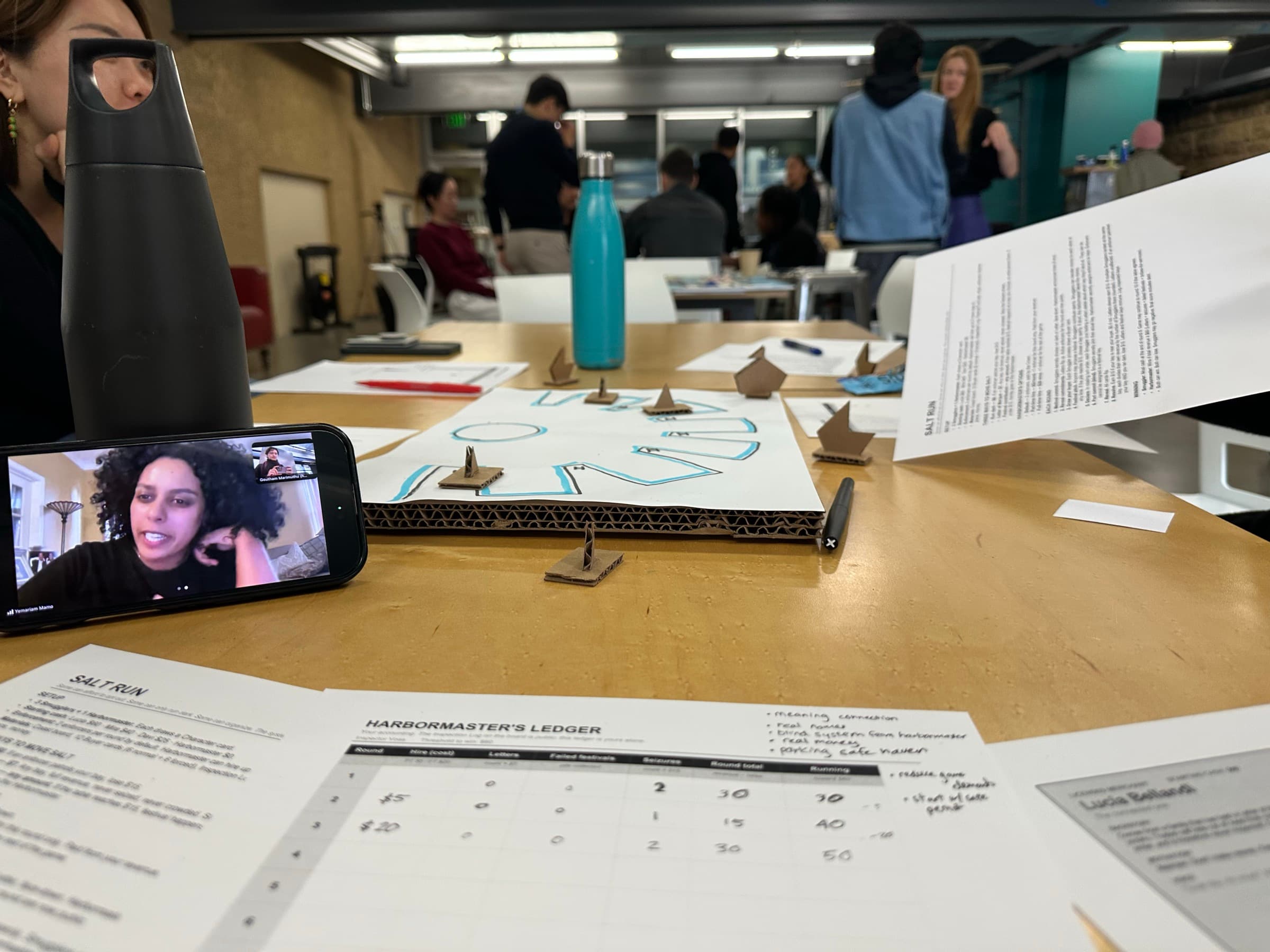
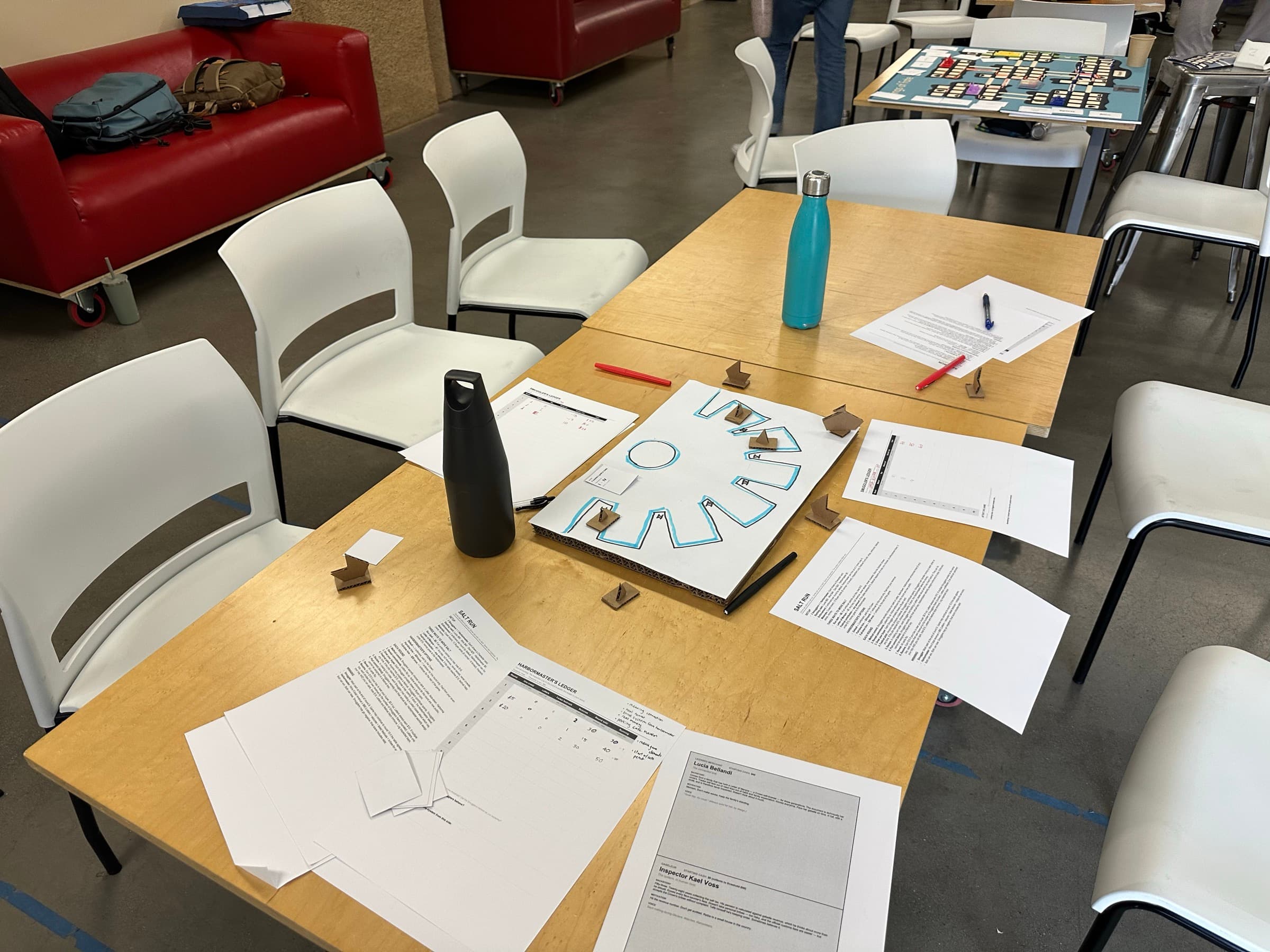
The game that ships is a 90-minute, four-player tabletop kit: an 11×17 board, twelve buyer cards, four character cards, two ledgers, and two rule sheets (one per role). It plays in eight rounds with a negotiable extension to ten. Setup is under five minutes.
What I’m most proud of is that the rules carry the argument on their own. Lucia’s $60 doesn’t need a paragraph explaining privilege. The starting balance does the work. The Harbormaster doesn’t need a villain monologue, just a pension threshold and a quiet seat at the table. Festivals don’t need a sermon about solidarity. They just need to fail sometimes.
The piece does what I wanted it to do. In the v3 playtest the shift happened somewhere in the middle rounds. Smugglers stopped talking about strategy and started talking about each other’s starting balances, about who could afford to be generous, about whether the Harbormaster was just doing his job. That was the recognition I was after.
The toolkit
Print it. Play it.
Everything you need is below. Print the board on 11×17, the cards on letter, hand the ledgers out, read the rules aloud. The game runs in about 90 minutes.
Lessons learned
A game about a system isn't the same as a game that is one.
Lizzie Magie invented The Landlord's Game in 1903 to teach people that monopolies were extractive. Parker Brothers bought it, stripped the critique, and sold Monopoly. The form survived. The argument didn't. I kept thinking about that the whole time I was making this.
The version of Salt Run that worked was the one where the rules carried the argument by themselves. Not flavor text on top of mechanics. Mechanics that produced the feeling on their own.
The other thing I learned is that specificity made it more universal, not less. The 18th-century salt tax is not a metaphor most playtesters arrived with. But once they were inside it, counting livres and deciding whether to fund a festival in Marseille, the structure became recognizable. Stanford parking, rent, healthcare, insurance. The game is really about whatever you bring to the table.
Next steps
If a team picked this up tomorrow.
Move it past pure tabletop.The current kit is paper, cards, and money. It works, but the format is doing less than it could. I want to explore a hybrid: a physical board for the Smugglers, and a quiet device or app for the Harbormaster. Tabletop carries the social weight of being at a table together. A screen can carry the asymmetry the role actually has.
Push on the blinding from the Harbormaster side.Right now the Harbormaster places enforcers in private, but the act is visible. Everyone sees the gesture, even if not the placement. I want to lean further into that asymmetry. What if the Harbormaster's decisions were made entirely out of view, and the Smugglers only learned of them at resolution? It would tilt the game closer to what an extractive system actually feels like, where the rule arrives after the fact and not during.
Capture the “surprise ticket” feeling.The thing I most want to design for is the moment a Smuggler discovers, too late, that they were the one being watched this round. Right now the reveal is communal. Everyone flips at once. I think there's a stronger version where the seizure feels like a ticket on a windshield: arriving uninvited, addressed to you specifically, with no one to argue with. A delayed, personalized reveal would do that work.
Make the whole thing more elegant.The rules are right. The kit isn't yet beautiful. The next iteration is fewer pieces, cleaner type, illustrated characters, a Harbormaster screen, and a print-and-play PDF with real trim marks. Same argument, quieter delivery.
One piece of advice for anyone moving this forward: don't smooth out the unfairness. The starting-cash gap between Lucia and Davi is the thing. Every playtester wants to balance it. Balancing it kills the game. Hold the line.